PI3K proteins sense mechanical forces in tumours.
PI3K
Cell signalling
Cancer
Mechanics
Mechanotransduction
Contact : Julie Guillermet-Guibert – et Mickaël Di-Luoffo – team SigDYN – Integration of cellular signals and PIK class I, II, III.
A tumour cell experiences mechanical forces of compression, traction and shear. These physical forces induce a signal in the cancer cell. The transmission of this signal is very fast and involves deformation of the cell. A huge current research effort is aimed at understanding how tumour cell deformations are translated into intracellular signals that promote tumour progression. A new avenue of research that we highlight in this article is the activation of the PI3K pathway.
The PI3K pathway is a target for new anti-cancer therapies. In this review article, the SigDYN team attempts to understand how these targeted therapies respond when tumour cells are subjected to mechanical forces and thus better predict their efficacy in patients.
Collaborations and acknowledgements
This work was carried out in collaboration with the Laboratory of Analysis and Architecture of Systems – LAAS – which is a research unit of the French National Centre for Scientific Research located at the Lespinet space complex in Toulouse. It benefits from the financial support of the Toulouse Cancer Health Foundation and the cancer plan.
One picture :
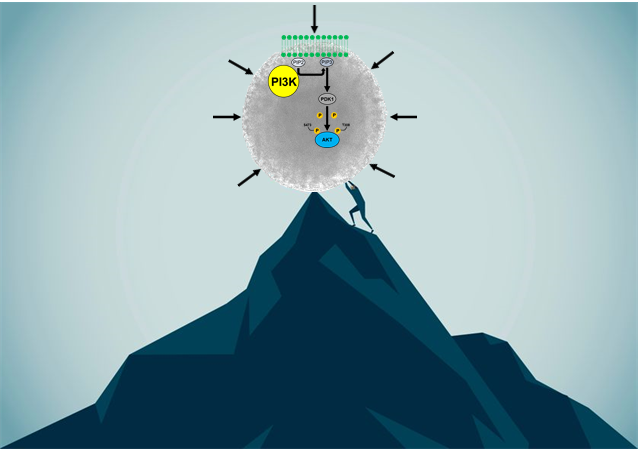
Finding the Achilles heel to target in pressurised cells: the importance of PI3K. Editing: Mickaël Di-Luoffo, adapted from erhui1979 – Getty
Discover the published article
Trends Biochem Sci. 2021 Jun 7;S0968-0004(21)00108-0.doi: 10.1016/j.tibs.2021.05.005. Online ahead of print.
PI3K functions as a hub in mechanotransduction
M Di-Luoffo , Z Ben-Meriem , P Lefebvre , M Delarue , J Guillermet-Guibert
Collaborations and acknowledgements



Toulouse Cancer Research Center (Oncopole)
Toulouse – FR
CRCT-Oncopole Follow 1,434 1,195
Compte officiel du Centre de Recherches en Cancérologie de Toulouse

 ;
;
Prize for the best communication at the French Association for Pancreatic Cancer Research (AFRCP) day for @BousquetVaysse team at @crctoncopole
➡️
Contact us
+33 5 82 74 15 75
Want to join
the CRCT team ?