Les procédés industriels des produits laitiers pourraient-ils influencer certains mécanismes liés au cancer du sein ?
Dairy products;
breast cancer;
nutrition;
oxysterols;
bioactive lipids;
ultra-processed foods;
cholesterol metabolism;
food processing
Marc Poirot Sandrine Silvente-Poirot – INOV – Cholesterol Metabolism and Therapeutic Innovations
The CRCT team INOV proposes a new conceptual framework linking dairy processing to the formation of bioactive lipid molecules potentially involved in breast cancer-related pathways. Published in Advances in Nutrition, this review opens new perspectives at the interface between nutrition, lipid biology and cancer research.
The INOV team at the Toulouse Cancer Research Center (CRCT) announces the acceptance of a review article in Advances in Nutrition: An International Review Journal, published by the American Society for Nutrition.
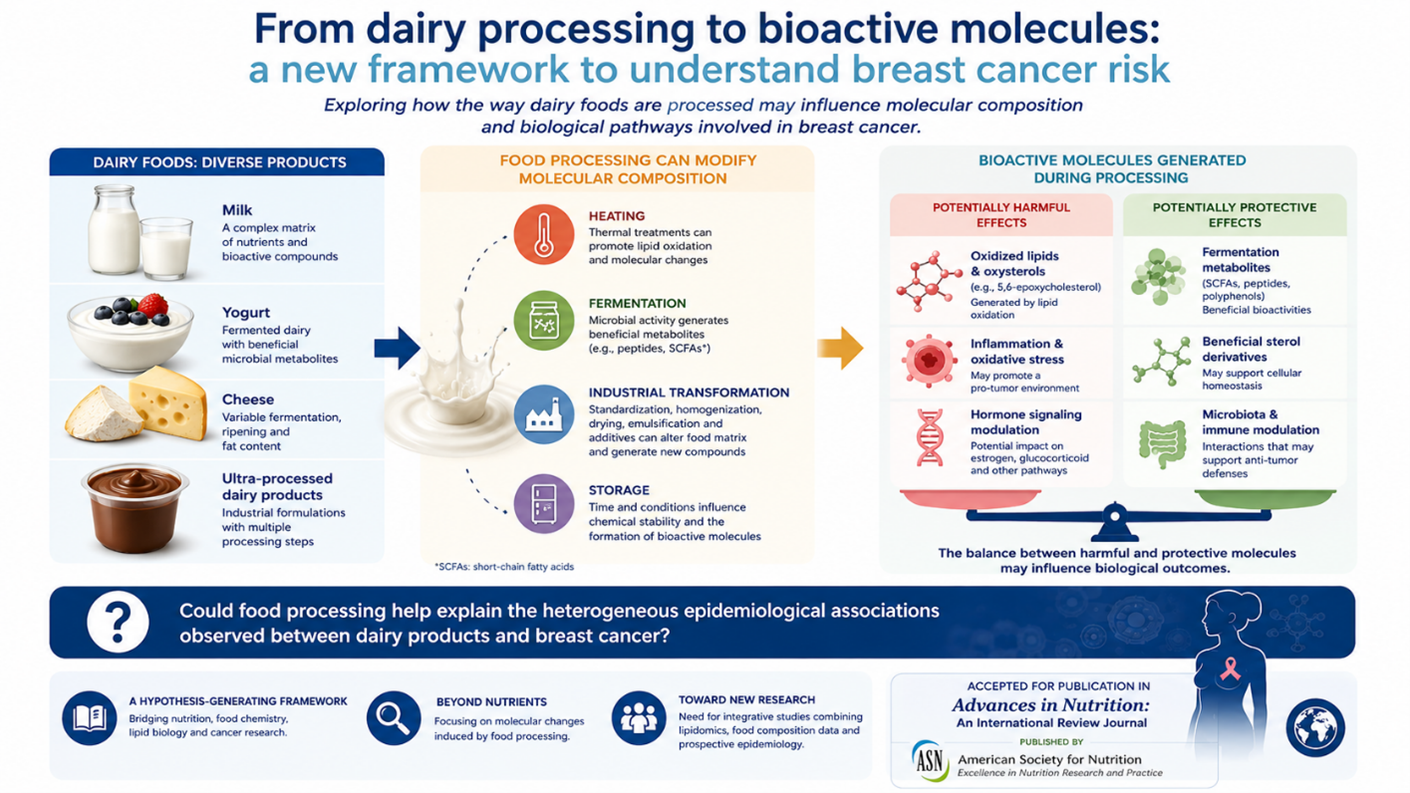
Entitled “Dairy Processing and Breast Cancer: A Hypothesis-Generating Framework Linking Bioactive Lipid Derivatives to Epidemiological Heterogeneity”, this article proposes an original framework aimed at better understanding the complex relationships between dairy consumption and breast cancer risk.
While epidemiological studies report highly heterogeneous associations depending on the dairy products investigated, the authors propose that technological food processing (heating, fermentation, storage, industrial transformation) may alter molecular composition and generate bioactive lipids capable of interacting with biological pathways involved in carcinogenesis.
The review particularly discusses the potential role of oxysterols, cholesterol-derived metabolites and lipid oxidation products, as well as the possible influence of fermentation-related metabolites.
This interdisciplinary work bridges nutrition, lipid biology, food chemistry and cancer research. It highlights the importance of moving beyond traditional nutrient-centered approaches and integrating molecular changes induced by industrial and food-processing technologies.
The authors emphasize the hypothesis-generating nature of this review and the need for future studies combining lipidomics, food composition databases and prospective epidemiological investigations.
Whilst this work has no immediate clinical application, it proposes a new conceptual framework that may improve our understanding of the relationships between diet, industrial processes and cancer. It could ultimately help to refine nutritional prevention strategies and future epidemiological studies.
This review opens up several avenues for research:
- the identification and quantification of bioactive lipids generated during food processing;
- the integration of lipidomic data into nutritional studies;
- the study of oxysterols and sterol derivatives in food products;
- the development of interdisciplinary approaches combining nutrition, molecular biology and food chemistry.
Discover the published article
Adv Nutr. 2026 Jun 15:100682. doi: 10.1016/j.advnut.2026.100682. Online ahead of print.
Dairy Processing and Breast Cancer: A Hypothesis-Generating Framework Linking Bioactive Lipid Derivatives to Epidemiological Heterogeneity
Silia Ayadi, Julio Buñay, Chloé Gressein, Laly Pucheu, Ben Allal, Philippe de Médina, Sandrine Silvente-Poirot, Marc Poirot
Collaborations et parterships
Collaboration and funding :
- Dr Ben Allal, Equipe DIAD, CRCT et Institut Claudius Regaud
- Inserm
- CNRS
- Université de Toulouse
- Institut National du Cancer (INCa)
- Agence Nationale de la Recherche (ANR)
- World Cancer Research Foundation
acknowledgement :
Réseau NACRe, ENOR network, associations ELLES, J’y V, Orange Care et URAFIKI JUU.