Improving the classification of pancreatic cancer: identification of a tumor subtype that is metabolically dependent on its environment.
Cancer‐associated fibroblast;
Serine metabolism.
Integrated stress response;
mRNA translation;
Pancreatic cancer;
Yvan Martineau – Micropanc – Microenvironnement and Therapeutic Resistance in Pancreatic Neoplasms
.
Pancreatic ductal adenocarcinoma (PDA) transcriptomic profiling has identified prognostic subtypes, yet patient-specific first-line therapies remain elusive. Here, we stratified PDA tumors by mRNA translation rates, a frequently dysregulated step in gene expression. Our analysis revealed a distinct tumorsubset with low global protein synthesis but activation of the Integrated Stress Response (ISR). These ISR-activated cancer cells exhibited broad chemoresistance and apoptosis resistance, yet were auxotrophic for serine due to impaired serine and cysteine biosynthesis. This vulnerability correlated with improved overall survival in patients. Notably, cancer-associated fibroblasts (CAFs) reprogrammed by ISR-activated cells, produced serine and sustained tumor growth in amino acid-depleted environments. Our findings demonstrate the power of translatome profiling to reveal stable, drug-resistant PDA cell states and identify a targetable CAF-tumor metabolic symbiosis.
This work contributes to refining pancreatic cancer classification beyond current transcriptomic approaches, with the aim of improving patient stratification. It also highlights the value of analyzing actively translated mRNAs as a functional proxy of cellular phenotype, that may inform therapeutic decision-making. It paves the way for the development of new therapeutic strategies targeting the tumor microenvironment, and more specifically the metabolic exchanges between cancer-associated fibroblasts and tumor cells.
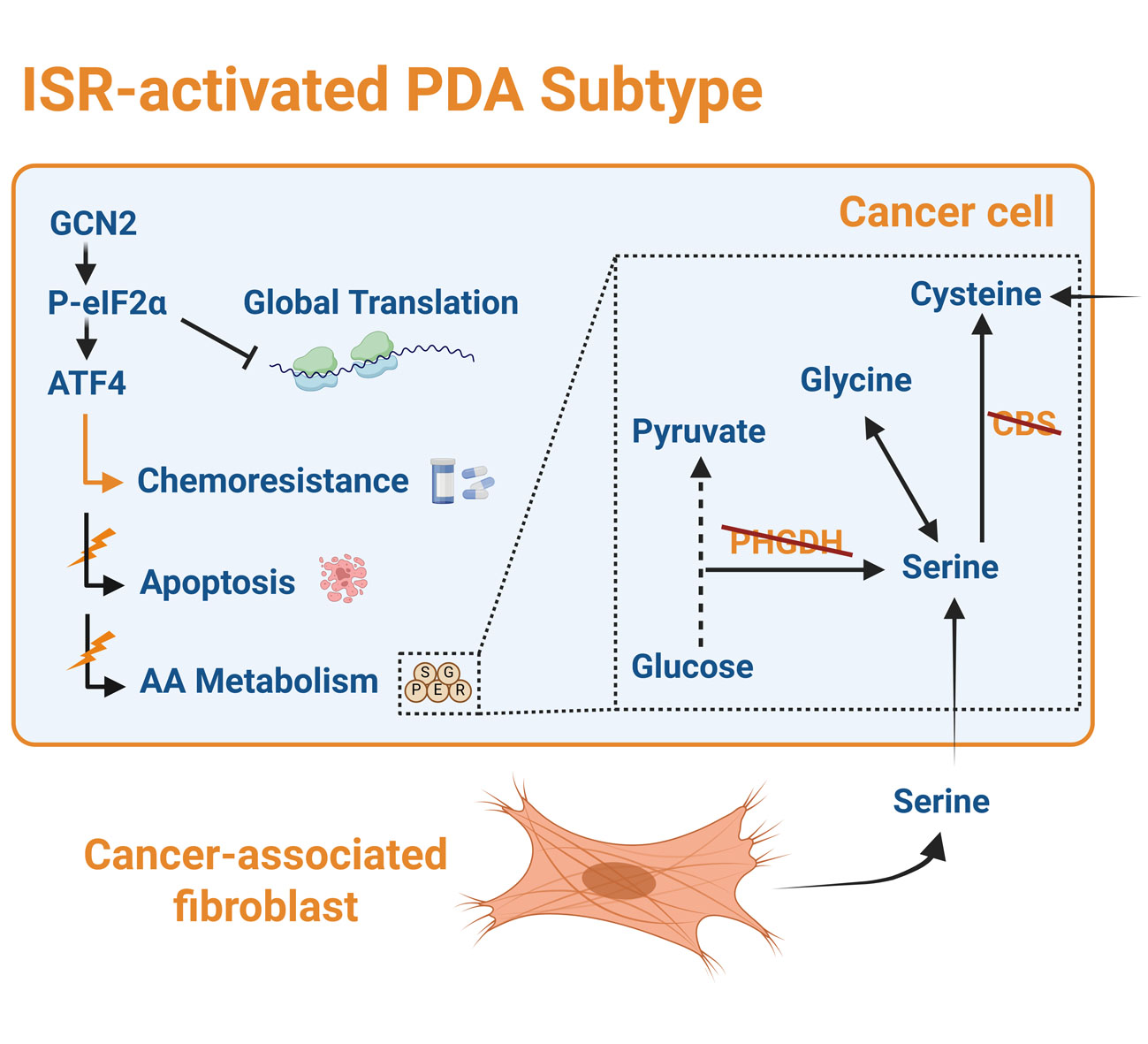
Graphical abstract:
Traductome profiling highlights the PDAC ISR-act subtype, which is characterized by constitutive activation of the Integrated Stress Response (ISR) pathway, leading to global inhibition of protein translation alongside selective translation of stress-related factors such as ATF4. This ISR activation is driven by the loss of PHGDH and CBS, two key enzymes required for the biosynthesis of serine and glycine, amino acids essential for numerous cellular functions. Cancer-associated fibroblasts within the tumor microenvironment compensate by supplying serine, thereby revealing therapeutic vulnerabilities, and opening new targeting opportunities for this highly chemoresistant subtype.
Discover the published article
Adv Sci (Weinh). 2026 Feb 17:e15740.doi: 10.1002/advs.202515740. Online ahead of print.
Decoding the Integrated Stress Response of Pancreatic Cancer: Identifying a Serine-dependent Tumor Subset Under Metabolic Relationships With CAFs
Sauyeun Shin, Mehdi Liauzun, Jacobo Solorzano, Morgane Le Bras, Christine Jean, Benjamin Fourneaux, Margaux Dore, Lea Fevrier, Ismahane Belhabib, Alexia Brunel, Cindy Neuzillet, Marion Larroque, Carine Joffre, Stephane Rocchi, Nicolas Fraunhoffer, Aurelie Perraud, Muriel Mathonnet, Vera Pancaldi, Laetitia Linares, Juan Iovanna, Nelson Dusetti, Ola Larsson, Remy Nicolle, Stephane Pyronnet, Corinne Bousquet, Yvan Martineau.
Collaborations and partnerships
Collaborations :
- Remy Nicolle (CRI -Paris)
- Vera Pancaldi (CRCT)
- Juan Iovanna-Nelson Dusetti-Nicolas Fraunhoffer (CRCM Marseille)
- Aurelie Perraud-Muriel Mathonnet (Faculty of Medicine, University Hospital of Limoges)
- Laetitia Linares – Benjamin Fourneaux – Marion Larroque (IRCM – Montepellier)
- Ola Larsson (Department of Oncology-Pathology Karolinska Institutet, Stockholm)
Remerciement a la plateforme technologique du CRCT (Loïc Van Den Berghe, Laetitia Ligat and Manon Farcé)
Founding :
- Ligue Nationale Contre le Cancer (LNCC)
- Institut National du Cancer (INCa)
- French National Research Agency (ANR)
- ARC Foundation
- PhD fundings: LNCC / Fondation Toulouse Cancer Sante / Region Occitanie / ARC foundation / Grant EUR-CARe

Toulouse Cancer Research Center (Oncopole)
Toulouse - FR
Follow us on social network
Contact us
+33 5 82 74 15 75
Want to join
the CRCT team ?