ESPRESSO: spatiotemporal omics based on organelle phenotyping
Microscopy,
Cancer,
Single cell,
Phenotyping.
Lorenzo Scipioni – OncoBreast – Advanced microscopy for the study of chemoresistance and heterogeneity in breast cancer
.
ESPRESSO is a new advanced imaging technology for spatiotemporal omics. The main idea is to overcome the limitations of conventional methods, which do not reveal where and when events occur in a cell. ESPRESSO uses sophisticated microscopy and computational analysis to track organelles (such as mitochondria and lysosomes) in real time and in 3D. By measuring changes in the shape and function of these organelles, researchers can obtain a dynamic profile of the cell. This method provides a better understanding of the cellular response to stress or treatments by linking these changes to genetic data. The technology has been validated on 3D cell cultures, providing a powerful tool for studying diseases such as triple-negative breast cancer.
Despite significant advances in treatment, one form of the disease remains particularly difficult to treat: triple-negative breast cancer (TNBC). This aggressive form, which affects around 9,000 women each year in France, is characterised by a high probability of relapse. Our observation is that in order to defeat this form of cancer, it is essential to understand why these cells develop resistance to chemotherapy. To answer these questions, the OncoBreast team in Toulouse has developed ESPRESSO (Environmental Sensors Phenotyping RElayed by Subcellular Structures and Organelles). ESPRESSO is a high-precision technology that allows us to observe the interior of cells, combining microscopy, chemical tools and artificial intelligence to monitor changes occurring in the ‘mini-organs’ of cancer cells in real time. By studying these changes, we hope to understand how cells become chemoresistant.
In the short term, we plan to use ESPRESSO to refine the diagnosis and prognosis of patients. The aim is to help doctors select the most effective treatment for each individual case, paving the way for even more personalised medicine. We are focusing on the early detection of recurrence risks. By identifying specific markers within cells, we hope to be able to detect relapses at their earliest stage, which will significantly increase the chances of long-term survival. In the long term, the ultimate ambition is to create an ‘atlas of breast cancer organelles’. This project will map the wide diversity of cells within a single tumour, a factor that greatly complicates treatment. This atlas will be a resource for the global scientific community and will contribute to the development of even more targeted and effective therapies.
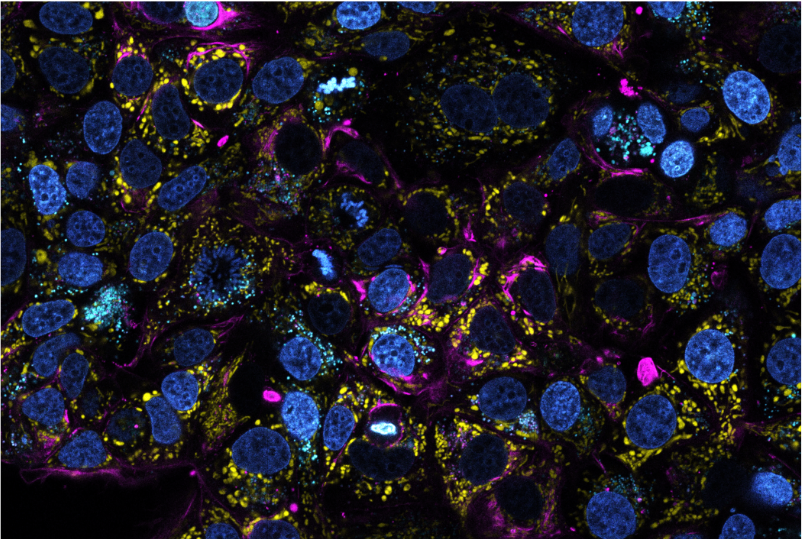
Breast cancer cell line labelled with dyes for mitochondria (yellow), nucleus (blue), cytoskeleton (magenta) and lysosomes (cyan)
Discover the published article
Nat Methods. 2025 Nov;22(11):2349-2361.doi: 10.1038/s41592-025-02863-4. Epub 2025 Nov 3.
ESPRESSO: spatiotemporal omics based on organelle phenotyping
Lorenzo Scipioni, Giulia Tedeschi, Mariana X Navarro, Yunlong Y Jia, Songning Zhu, Lila P Halbers, Melody Di Bona, Scott X Atwood, Jennifer A Prescher, Enrico Gratton, Michelle A Digman
Collaborations and partnerships
This work was funded by the Toulouse Cancer Health Foundation (Oncobreast Chair to L.S.), National Science Foundation grants CBET2134916 to S.X. A. and Y.Y.J., and 1847005 to M.A.D., as well as by the Allen Distinguished Investigator Award, a grant advised by the Paul G. Allen Frontiers Group of the Paul G. Allen Family Foundation (to J.A.P. and M.A.D.). The authors acknowledge the Fluorescence Dynamics Laboratory (P41GM103540), the American Italian Cancer Foundation (to M.D.B.), the Chao Family Comprehensive Cancer Centre Genomics High-Throughput Facility Shared Resource, supported by the NIH NCI under grant number P30CA062203, and the UCI Skin Biology Resource Centre supported by NIAMS under grant number P30AR075047. P30CA062203, and the UCI Skin Biology Resource Centre, supported by NIAMS under grant number P30AR075047.

Toulouse Cancer Research Center (Oncopole)
Toulouse - FR
Follow us on social network
Contact us
+33 5 82 74 15 75
Want to join
the CRCT team ?