Oncogenesis of sarcomas
Frédéric Chibon
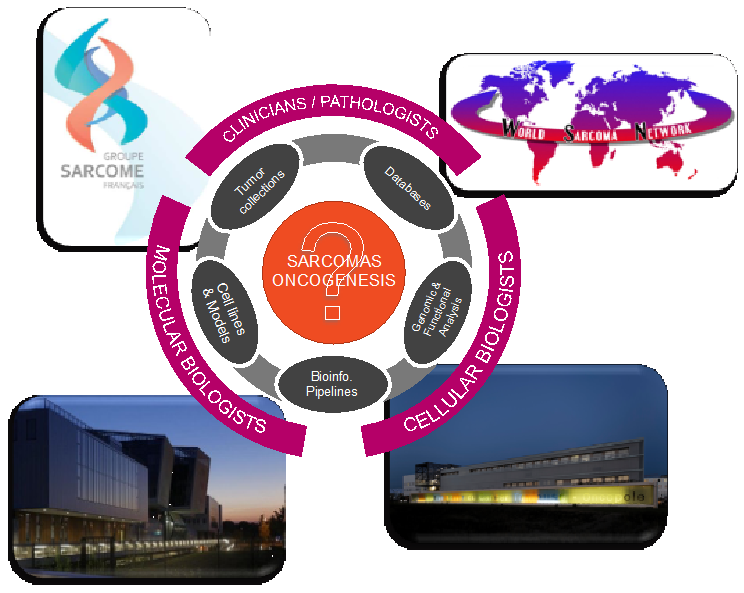
The team seeks to understand the chromosomal mechanisms of the oncogenesis of pleomorphic sarcomas, characterised by a very high chromosomal instability. The team has identified certain important players in this oncogenesis (MDM2, CDK4, TP53, RB1, MYOCD1) and linked the aggressiveness of the tumours to this chromosomal instability, but the major determinants are still not known. The work now focuses on 2 main research axes on these tumours: i) the study of the oncogenic programme at the unicellular and spatial levels, and ii) the study of cellular mechanisms, in particular the cellular fusion of tumour cells that the team has observed in these tumours. This study showed in particular that this cell fusion in an oncogenic context results in a significant remodelling of both the cell metabolism and the tumour genome, producing hybrids recapitulating the pathology described in the patients.
The results of this work are envisaged in a context of transfer towards the improvement of patient care. The team is developing tools to optimise the diagnosis and evaluation of patient evolution. This work has enabled the transfer of a quasi-universal expression signature that the team had identified to a technology adapted to patient management. Clinical trials based on the application of this signature are underway and one of them, supported by the IUCT-Oncopole, started in 2020.