ESTELLE ESPINOS
INVESTIGUATEURS ASSOCIES : STEPHANE MANENTI, ANNE CAMMAS ET STEFANIA MILLEVOI
Lien Entre ARN & Autophagie
BACKGROUND
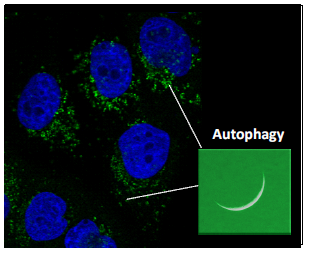
Adaptation to stress, which allows cancer cells to survive under unfavorable conditions, is essential for the development of resistance to therapies. A major challenge in basic and clinical research is to identify and better understand the underlying regulatory mechanisms. Autophagy is one of the most studied stress response mechanisms: by ensuring the degradation of cellular components and the recycling of the products of this degradation, this process allows cells to survive in response to multiple stresses. Pharmacological manipulation of autophagy appears promising in overcoming these resistance mechanisms. New evidence points to the prominent role of RNA and RNA-binding proteins (RBPs) in the regulation of autophagy, and opens a new field of investigation that will lead to a better understanding not only of autophagy itself, but also of its interconnection with other processes related to cancer.
ACHIEVEMENTS
S. Manenti and E. Espinos have contributed to reinforce the attractiveness towards therapeutic strategies targeting autophagy in FLT3-ITD LAM s (Heydt, Q. (2018) Oncogene) but also in ALK-positive Large Cell Anaplastic Lymphomas (ALCL) (Mitou, G. (2015) Oncotarget). We have shown that autophagy is regulated by small non-coding RNAs (Sorrentino, D. (2020) Cancers), cell cycle regulators (Nowosad, A.J. (2020) Nat. Cell. Biol.), oncogenic signaling (Heydt, Q. (2018 Oncogene), regulators of apoptosis (Torossian, A. (2019) Haematologica), and proteasome inhibitors (Larrue, C. (2016) Blood). We also demonstrated that mitochondria control autophagy to regulate the availability of fatty acids to oxidative phosphorylation, creating a mechanistic link between autophagy and tumor metabolism (Bosc, C.B. (2020) Nat. Comm).
ONGOING/FUTURE PROJECTS
The overall goal of this project is to fill the gap in knowledge on the role of RNA and post-transcriptional regulations in the control of selective and non-selective autophagy, and their interconnection with other stress response pathways. We will focus on the role of unorthodox RBPs, such as protein factors with non-canonical RNA binding domains known to be involved in other processes impacting cancer, such as the immune response or DDR checkpoints.