Antitumor immunity extends beyond immunotherapy.
T-cell exhaustion,
Homologous recombination deficiency,
Ovarian cancer.
Anna Salvioni – T2i – Anti-tumour immunity and immunotherapy
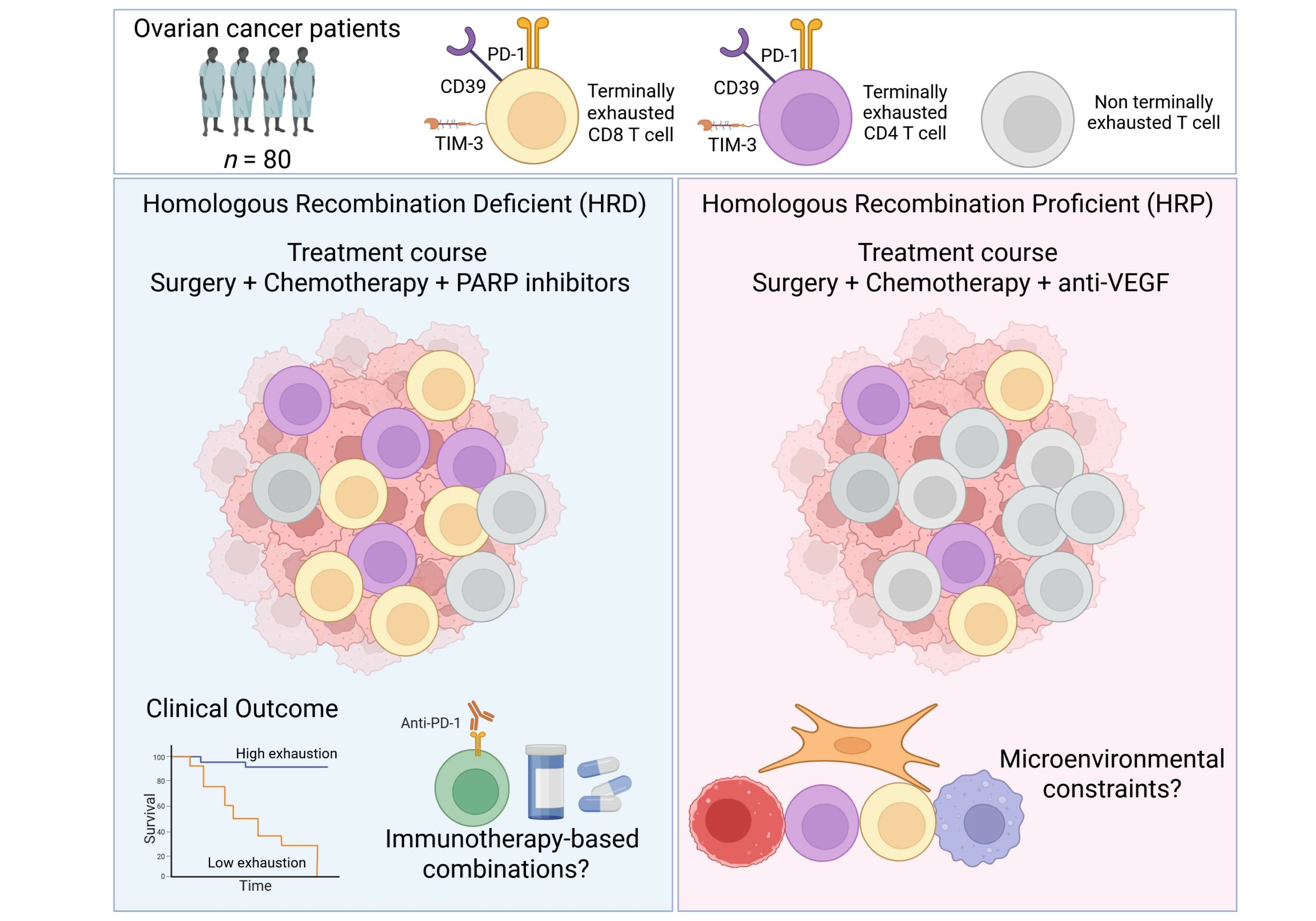
In advanced ovarian cancer, tumor infiltration by terminally exhausted T cells is increased in cancers with DNA-repair deficiencies (HRD) compared to those that are DNA-repair proficient (HRP). Whereas terminal T cell exhaustion has been widely considered in the context of immunotherapy, the results of this study uncover its favorable prognostic value in patients with HRD tumors outside of an immunotherapy context.
Ovarian cancer is often diagnosed at advanced stages, when treatment options are limited. In this study, we examined 80 patients with advanced disease and focused on T-cell exhaustion, a state in which tumor-specific T cells express inhibitory signals and display reduced effector function. These lymphocytes are the main targets of current cancer immunotherapies.
We found that tumors with defects in DNA repair (known as HRD) contain higher proportions of these exhausted T cells than tumors with intact DNA repair (HRP). This was observed even though both groups showed similar overall degrees of T-cell infiltration.
When we examined patient outcomes under standard treatments (which did not include immunotherapy), an interesting pattern emerged: among HRD patients, a higher proportion of exhausted T cells was associated with better clinical outcomes, reflected by longer progression-free survival.
These results suggest that the type and functional state of T cells may be more important than their sheer number. While T-cell exhaustion is already recognized as clinically relevant in patients receiving immunotherapy, our findings indicate that it may also have prognostic value in more conventional treatment settings.
Our results also highlight the immunogenic nature of HRD tumors and suggest that ovarian cancer patients with such tumors could benefit from new combination strategies incorporating immunotherapy.
Discover the published article
NPJ Precis Oncol. 2026 Apr 10.doi: 10.1038/s41698-026-01412-2. Online ahead of print.
Terminal T-cell exhaustion predicts tumor control independent of immunotherapy in ovarian cancer
Anna Salvioni, Marie Michelas, Mathilde Del, Pierre Vuattoux, Bertille Segier, Clara-Maria Scarlata, Noémie Thébault, Giulia C Leonardi, Nathalie Van Acker, François-Xavier Frenois, Virginie Feliu, Myriam Maixent, Lise Scandella, Sylvie Giuriato, Claire Illac, Sarah Betrian, Charlotte Chollet, Bastien Cabarrou, Carlos Martinez-Gomez, Christel Devaud, Ayman Al Saati, Christine Toulas, Thomas Filleron, Guillaume Bataillon, Jean-Pierre Delord, Maha Ayyoub, Alejandra Martinez
Collaborations and partnerships
Founding :
- Ligue contre le cancer,
- American Association for Cancer Research (AstraZeneca Ovarian Cancer Research Fellowship)
.