

- Cet évènement est passé.
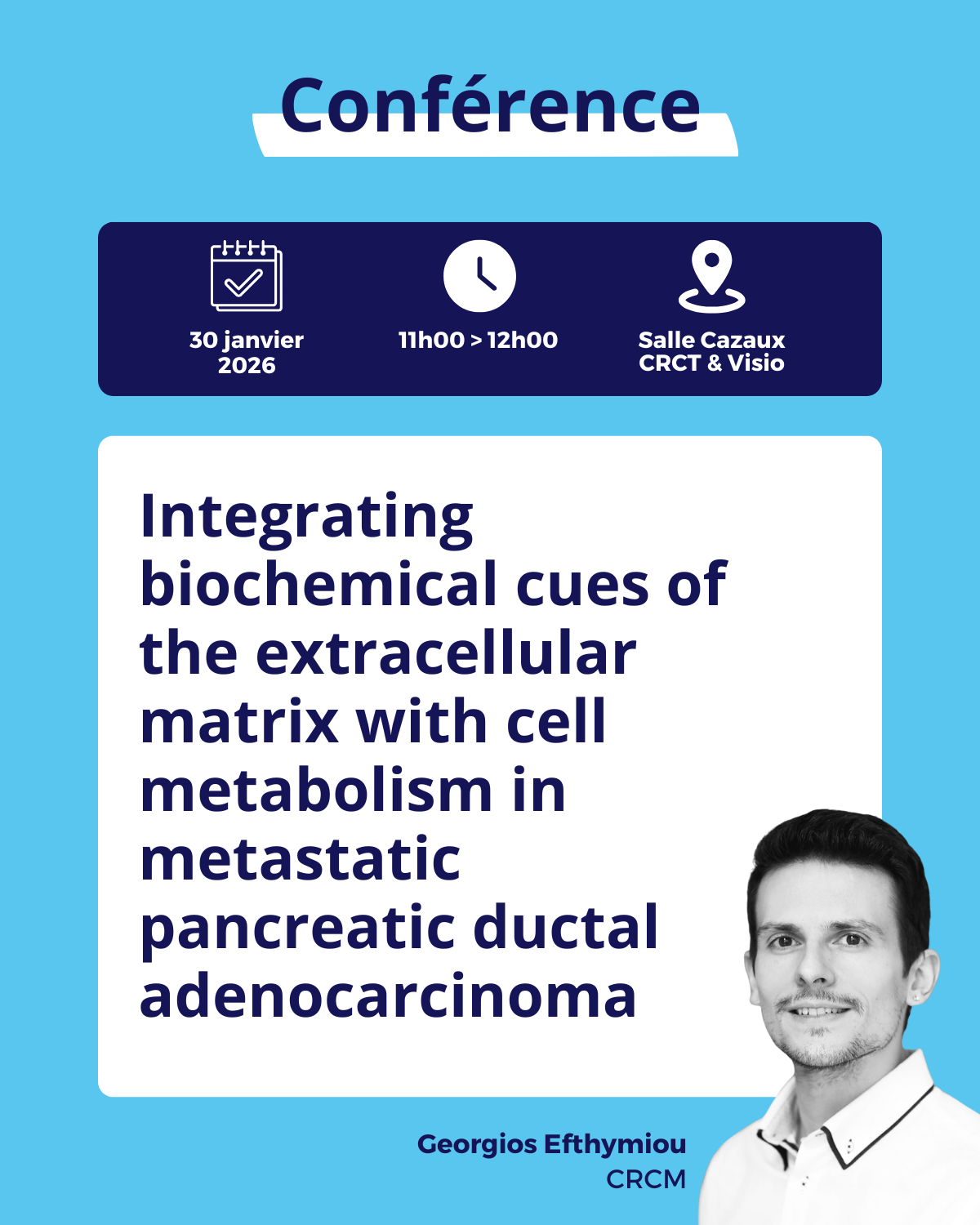
Conférence | Integrating biochemical cues of the extracellular matrix with cell metabolism in metastatic pancreatic ductal adenocarcinoma – Georgios Efthymiou, CRCM
Abstract :
Pancreatic ductal adenocarcinoma (PDAC) is a highly aggressive and lethal cancer with worryingly increasing incidence in developed countries. Key aspects that underline PDAC aggressiveness are the pronounced desmoplasia and the metabolic adaptability, features that are commonly found in the primary and the metastatic site. Desmoplasia refers to the enhanced production and deposition of extracellular matrix (ECM) components, which results to dramatic alterations in tissue architecture. Within this metabolically challenging tumor microenvironment (TME), tumor cells promote metabolic adaptations to maintain tumorigenic properties, including proliferation, chemoresistance, and metastatic dissemination and expansion.
In this talk I will illustrate examples of ECM-driven tumorigenic properties, such as the capacity of cells to alleviate the effects of chemotherapy by promoting DNA repair mechanisms. I will also present ECM-driven metabolic adaptations in the primary PDAC that contribute to chemoresistance. More specifically, I will focus on the nucleotide imbalance observed in PDAC, and reported in other solid cancers, and describe the role of guanylates as mediators of chemoresistance. Relevant strategies to improve responses to therapy will be discussed.
Finally, I will share preliminary results on the emerging notion of the liver pre-metastatic niche (PMN) in PDAC. The PMN comprises ECM and metabolic alterations that favor metastatic cell seeding and subsequent metastatic expansion. The exploration of these alterations may help slow down or halt metastatic dissemination and increase the number of eligible patients for surgical resection.
Pour suivre la conférence à distance, cliquez ici.