

- Cet évènement est passé.
Conférence Alexander Hoffman : Hematopoietic Decline during Inflammaging: Models expose multiple mechanisms
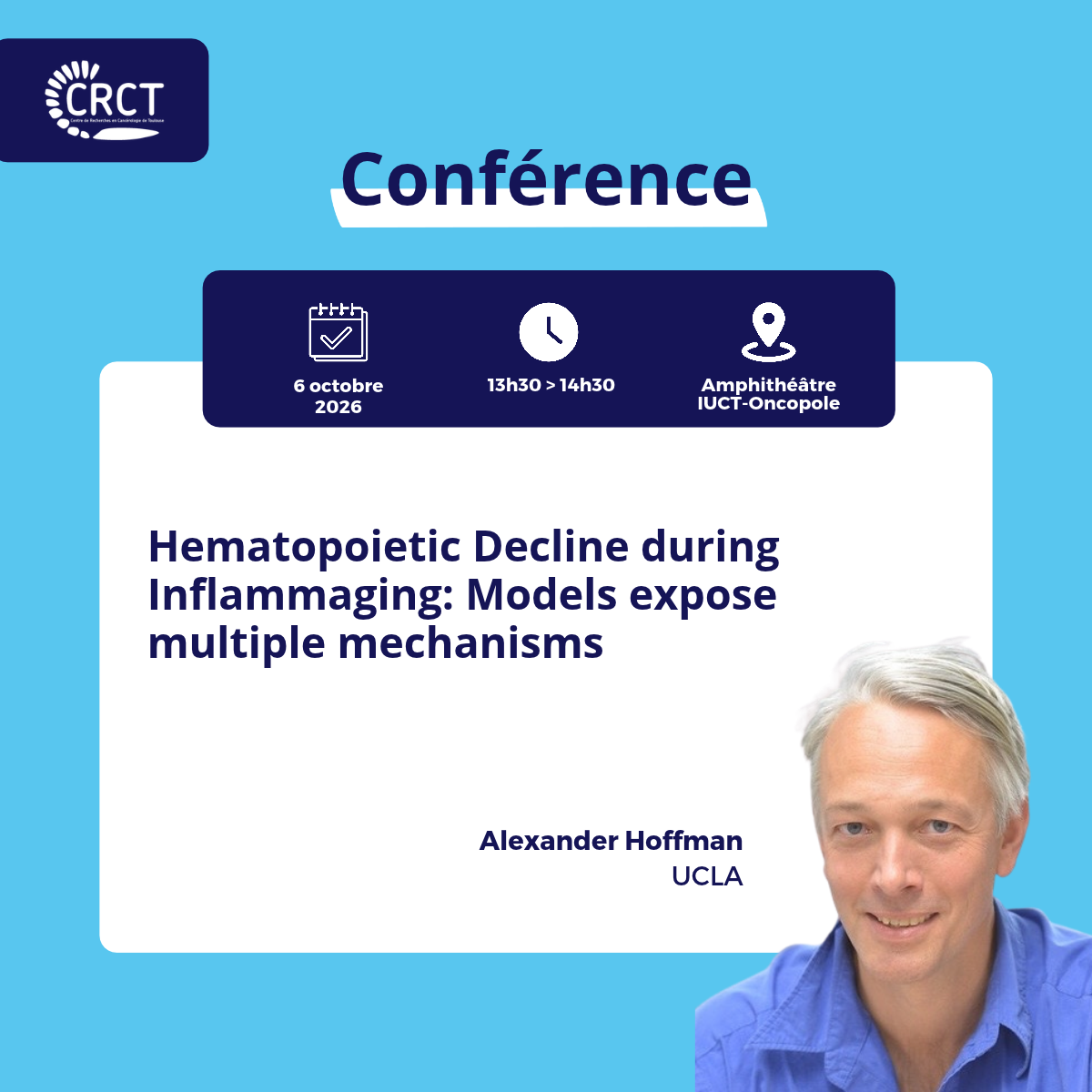
Hematopoietic Decline during Inflammaging: Models expose multiple mechanisms
Alexander Hoffmann
Department of Microbiology, Immunology, and Molecular Genetics
Institute for Quantitative and Computational Biosciences
UCLA, Los Angeles, CA 90066
The effectiveness of the immune system declines with age and associated chronic inflammation, termed “Inflammaging”. Most marked is the reduction in B-cell populations, and their hematopoietic progenitors are myeloid biased. Furthermore, hematopoietic stems cells (HSCs) are functionally impaired to populate the bone marrow niche when transplanted, yet they become overabundant. To what extent these aging hallmarks are related, as cause or consequence, remains unclear. I will summarize three studies in which we developed experimental and mathematical models to dissect the age-associated dysregulation quantitatively and identified distinct mechanisms triggered by inflammation.
Chia J.J., Singh, A., Lin, Y.-S., Popko, N., Mastro, D., Liu, Y., Tran, T., King, J.K., Rao, D.S., Hoffmann, A. 2025 Distinct roles for NFκB in hematopoietic stem cells and the bone marrow milieu in promoting hematopoietic aging. Cell Reports 44, 116193. PMID: 40875292, PMC12515102
Singh, A., Chia, J.J., Rao, D.S., Hoffmann, A. 2025 Population dynamics modeling reveals that myeloid bias involves both HSC differentiation and progenitor proliferation biases. Blood, 145, pp.1293-1308. PMID: 39791596, PMC11952015
Lin, Y-S., Alonso V., Singh, A., Liu, Y., Tang, Y., Mehta, A., King, J.K., Paing, M., Salomonis, N., Grimes, H.L., Chia, J.J., Rao, D., Hoffmann, A. 2026 Dynamic NFκB control during B-lymphopoiesis ensures proteostasis to enable phased proliferation and differentiation decisions. Cell Press Blue, 1 (3), 100051
Liu, Y., Rodriguez, B., Daly, A., Tang, Y., Lin, Y-S., Shahabi, S., Harriott, N., Smale, S.T., Ghosh, G., Rao, D., Chia, J.J., Hoffmann, A. 2026 Deficiency in NFkb1 extends the self-renewal capacity of Flt3L-responsive hematopoietic progenitors via an imbalanced, chronically active NFκB system. Cell Press Blue, in review
Alexander Hoffmann is Distinguished Professor and Thomas M Asher Professor in the Department of Microbiology, Immunology, and Molecular Genetics at UCLA, He is also founding director of the Institute for Quantitative and Computational Biosciences (QCBio) to catalyze, promote, and guide the transformation of biological- and biomedical sciences into a data-rich, theory-based, quantitatively predictive science. QCBio initiates, supports and coordinates almost a dozen research, research training, and education programs in quantitative and computational biosciences.
His research aims to develop a predictive understanding of immune responses, focusing on immune sentinel macrophages, the generation of antibody responses in lymphnodes, and the impact of inflammation on the generation of new immune cells in the bone marrow.
Before joining UCLA in 2014, he was Professor of Biochemistry at UCSD; there he founded the San Diego Center for Systems Biology (SDCSB), co-founded the BioCircuits Institute, and directed the Graduate Program in Bioinformatics and Systems Biology. He holds degrees in Physics and Zoology (BA, Cambridge University), Biochemistry and Molecular Biology (Ph.D., Rockefeller University) and owes his training to Robert Roeder and David Baltimore, as well as his many students, postdocs and collaborators.