

Conférence Anna Labernadie – Micro Immune Response On-chip (MIRO) : a model of tumour-stroma interface for immunotherapy testing
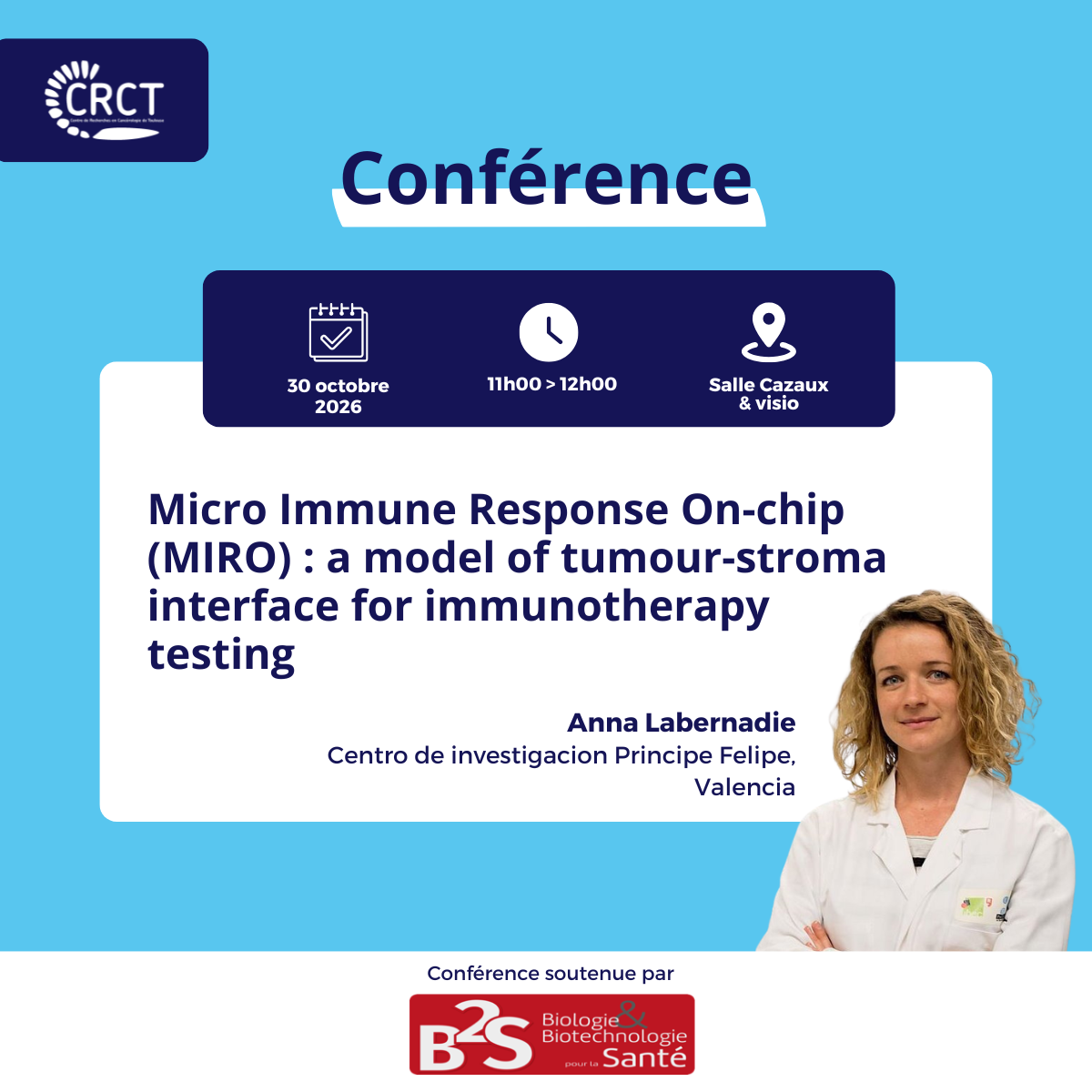
Micro Immune Response On-chip (MIRO): a model of tumour-stroma interface for immunotherapy testing
Dr Anna Labernadie – Group Leader Cell Behaviour and Tissue Bioengineering Team, Príncipe Felipe Research Center (CIPF) Valencia Spain
Conference sponsored by SFR B2S on Friday October 30th 2026
Abstract:
Immunotherapies represent a major advance in cancer treatment, yet only 20–40% of patients derive benefit. To improve treatment prediction, models that accurately reflect tumour architecture and the interplay between cancer cells and the microenvironment are essential. In this study, we introduce Micro Immune Response On‑chip (MIRO), an ex vivo platform that generates 3D barriers built by cancer‑associated fibroblasts (CAFs) and their secreted extracellular matrix, which enclose cancer cell clusters. We applied MIRO to study resistance to antibody‑dependent cellular cytotoxicity (ADCC) under targeted therapies. Our results indicate that stromal barriers are associated with immune exclusion and reduced ADCC efficacy. We further show that IL2 stimulation enhances immune cell velocity, counteracting stromal immunosuppression. This restoration of immune activity demonstrates the ability of IL2 to overcome stroma‑mediated resistance. Overall, MIRO emerges as a translational platform for drug testing and for evaluating novel immunotherapeutic strategies.
Pour suivre la conférence en direct, veuillez cliquer ici.
Bio:
Dr. Anna Labernadie heads the Cell Behaviour and Tissue Bioengineering group at the Príncipe Felipe Research Center (CIPF) in Valencia. Her work centers on mechano-oncology, with a particular focus on how mechanosensing shapes tumor dissemination and modulates immune responses in cancer. To investigate these processes, her team integrates biophysical methods, cellular co-culture systems, and organ-on-chip technologies, aiming to replicate the physical constraints, cell–cell interactions, and spatial organization characteristic of tissues and tumors.
She earned her PhD in Cell Biology from the University of Toulouse in 2012, and then conducted postdoctoral research in the laboratory of Xavier Trepat at IBEC (Barcelona), where she studied the physical interplay between tumor cells and stromal fibroblasts during cancer progression. In 2022, she was awarded a Ramón y Cajal Fellowship, enabling her to establish her independent research group at the CIPF.
Her team actively collaborates with academic, clinical, and industrial partners to develop advanced on-chip platforms for investigating cell mechanics across a wide range of physiological and disease contexts.
Web: https://www.cipf.es/
Publications:
Micro Immune Response On-chip (MIRO) models the tumour-stroma interface for immunotherapy testing. Perucca A, Llonín AG, Benach OM, et al., Nature Communications 2025 Feb, DOI: 10.1038/s41467-025-56275-1.
Membrane to cortex attachment determines different mechanical phenotypes in LGR5+ and LGR5- colorectal cancer cells. Conti S, et al., Nature Communications 2024 Apr, DOI: 10.1038/s41467-024-47227-2.
A mechanically active heterotypic E-cadherin/N-cadherin adhesion enables fibroblasts to drive cancer cell invasion. Labernadie A, et al., Nature Cell Biology 2017 Mar, DOI: 10.1038/ncb3478.
Protrusion force microscopy reveals oscillatory force generation and mechanosensing activity of human macrophage podosomes. Labernadie, A., et al., Nature Communications 2014, DOI: 10.1038/ncomms6343.